
























































































































































Early Pregnancy Symptoms Before a Missed Period: When to Test
Author: RVLNSV PRASAD
Updated On: September 2026
About Us
Author Bio
Editorial Policy
Contact Us
Introduction
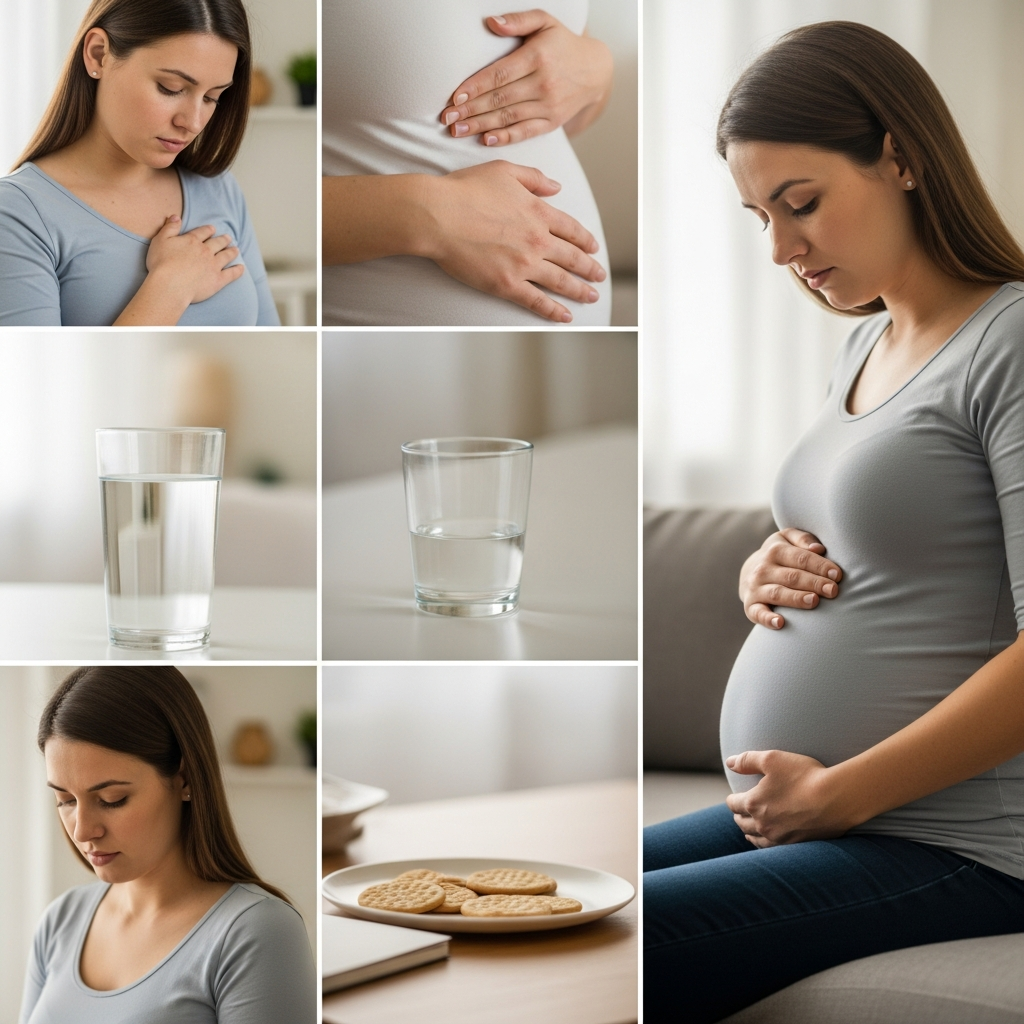
Waiting to find out whether you are pregnant can make every small body change feel important.
A little cramping may suddenly make you wonder whether implantation has occurred. Breast tenderness may seem different from your usual premenstrual symptoms. You may feel unusually tired, notice stronger smells, or simply feel that something is not quite the same.
The difficult part is that early pregnancy symptoms before a missed period are not reliable enough to confirm pregnancy on their own.
Many early pregnancy symptoms overlap with premenstrual syndrome (PMS), normal hormonal changes, stress, illness, and other conditions. The most dependable way to find out is a properly timed pregnancy test.
Mayo Clinic explains that symptoms such as breast tenderness and fatigue can occur in early pregnancy but can also have other causes, which is why a pregnancy test is more useful than symptoms alone. Mayo Clinic’s explanation of early pregnancy symptoms
This guide explains what you may notice before a missed period, what those symptoms can and cannot tell you, the best time to test, what a negative or positive result means, and which symptoms require prompt medical attention.
Quick Answer
Can you have early pregnancy symptoms before a missed period?
Yes. Some people notice physical changes before their expected period, while others have no symptoms at all.
Possible early signs include:
- Breast tenderness
- Fatigue
- Mild cramping
- Light spotting
- Increased urination
- Changes in smell or taste
- Food aversions or cravings
- Mood changes
- Bloating
- Increased vaginal discharge
However, none of these symptoms can confirm pregnancy by itself.
The most reliable practical step is to take a home pregnancy test at the appropriate time. Most pregnancy tests are most reliable from the first day of a missed period. NHS guidance on when to take a pregnancy test
Key Takeaways
- Early pregnancy symptoms can occur before a missed period, but not everyone experiences them.
- PMS and early pregnancy can produce many of the same symptoms.
- A missed period is an important clue, but it does not prove pregnancy.
- A pregnancy test detects the hormone human chorionic gonadotropin (hCG).
- Testing too early is one of the main reasons for a false-negative result.
- If your test is negative but your period still does not arrive, repeat the test after several days or contact a healthcare professional.
- A positive home pregnancy test usually means pregnancy is present, but appropriate healthcare follow-up is still important.
- Light spotting can occur in early pregnancy, but bleeding has many possible causes.
- Severe pelvic or abdominal pain, shoulder pain, fainting, weakness, or significant bleeding require prompt medical evaluation.
- If pregnancy is possible, sensible health measures can be started before confirmation rather than waiting for symptoms to become obvious.
What Happens in Very Early Pregnancy?
Pregnancy does not begin with a sudden collection of symptoms.
A series of biological events occurs first.
After ovulation, fertilization can occur if sperm meets an egg. The resulting embryo travels toward the uterus and eventually may implant in the uterine lining.
After implantation, cells associated with the developing pregnancy begin producing human chorionic gonadotropin (hCG).
This hormone is what pregnancy tests detect.
The amount of hCG rises during early pregnancy, which is one reason a test taken several days later can be positive after an earlier test was negative. Mayo Clinic explains that hCG rises quickly during early pregnancy and that testing later can improve the chance of detecting it. Mayo Clinic’s current 2026 guide to home pregnancy tests
This timing explains an important point:
You may be pregnant before a pregnancy test can detect enough hCG to produce a positive result.
That does not mean symptoms can reliably tell you that pregnancy has occurred.
Can Early Pregnancy Symptoms Start Before a Missed Period?
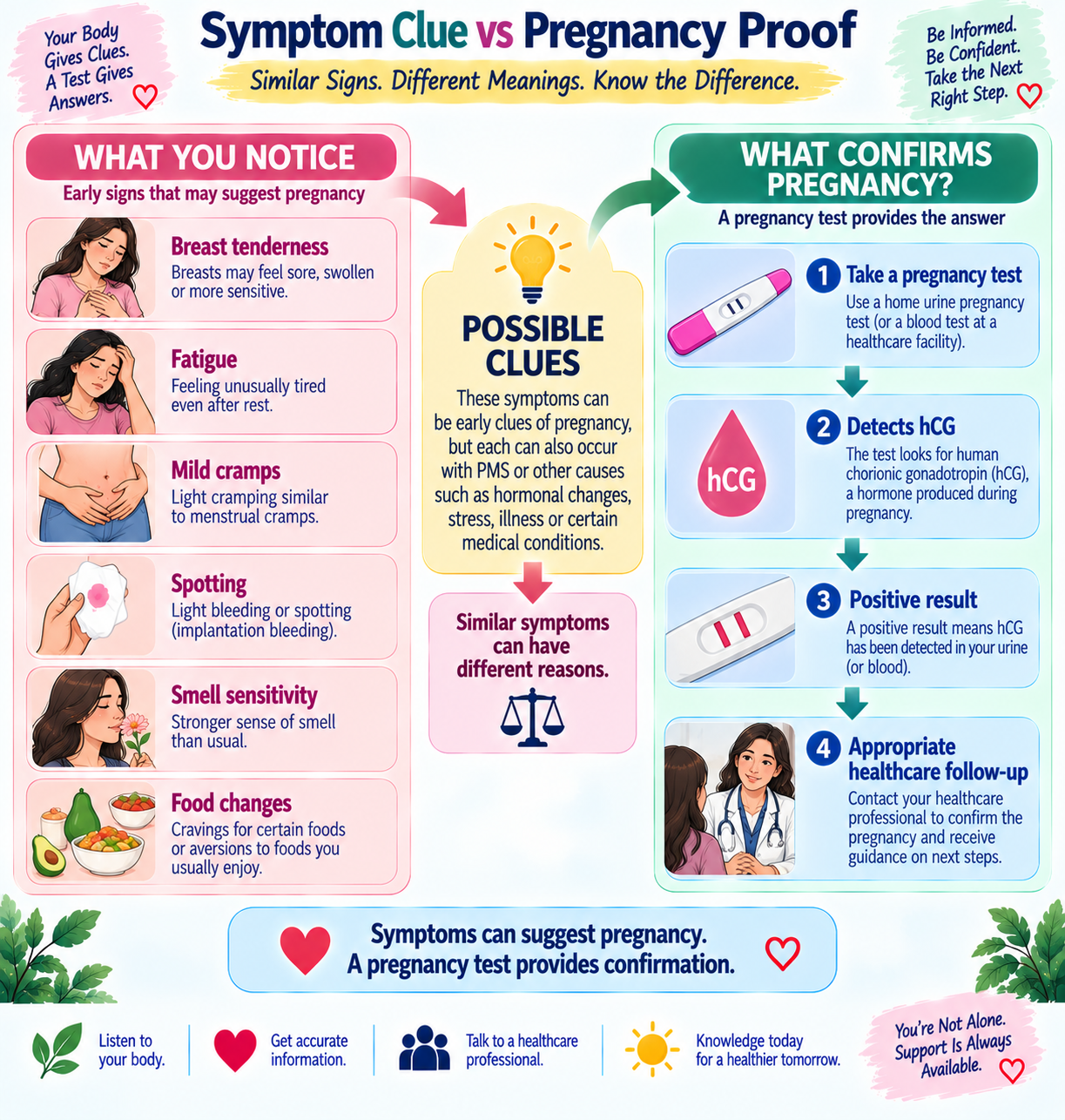
Yes, but the timing varies considerably.
Some people notice changes before their expected period. Others do not notice anything until after the missed period. Some have very few symptoms throughout early pregnancy.
The NHS lists symptoms such as a missed period, light spotting, nausea, tiredness, sore breasts, frequent urination, constipation, increased vaginal discharge, smell sensitivity, food changes, and mood changes among possible early signs. NHS information about early pregnancy symptoms
The important word is possible.
These symptoms are clues, not proof.
1. A Missed Period
A missed period is often the first noticeable sign that leads someone to consider pregnancy.
If your menstrual cycles are usually regular and your period does not arrive when expected, pregnancy becomes one possible explanation.
However, a late period can also happen because of:
- Stress
- Changes in body weight
- Heavy exercise
- Illness
- Hormonal conditions
- Irregular ovulation
- Certain medications
- Changes in contraception
Therefore, a missed period is a reason to test, not a diagnosis by itself.
Mayo Clinic notes that a missed period can be an important early sign but may be misleading when menstrual cycles are irregular. Mayo Clinic’s overview of pregnancy symptoms
2. Breast Tenderness or Swelling
Hormonal changes can make the breasts feel:
- Tender
- Full
- Heavy
- Swollen
- More sensitive
The nipples may also feel more sensitive.
The problem is that breast tenderness is also very common before menstruation.
This makes breast changes a poor standalone method of pregnancy confirmation.
If your breasts feel different from your usual PMS pattern, it can be worth noticing, but a test is still needed.
3. Unusual Fatigue
Some people describe early pregnancy fatigue as unusually strong.
You may feel tired after activities that normally would not exhaust you.
Hormonal changes are one possible reason, but fatigue is not specific to pregnancy.
Poor sleep, stress, anemia, illness, emotional strain, and changes in daily routine can also make you tired.
Therefore, fatigue becomes more meaningful when it occurs alongside a missed period or other pregnancy clues, but it still cannot confirm pregnancy.
4. Mild Cramping
Mild lower-abdominal cramping can occur around the time a period is expected.
Some people associate mild cramping with implantation, but it is difficult to determine from symptoms alone whether implantation has actually occurred.
Menstrual cramps can feel similar.
Gas, bowel changes, and normal hormonal fluctuations can also cause abdominal discomfort.
So avoid trying to diagnose pregnancy based on the exact location or sensation of mild cramps.
When Cramping Is Not Something to Ignore
Severe, worsening, or one-sided pelvic or abdominal pain is different.
Pain accompanied by bleeding, dizziness, weakness, or fainting can require urgent assessment.
ACOG explains that ectopic pregnancy can initially resemble a normal early pregnancy but may later cause abdominal or pelvic pain, abnormal bleeding, shoulder pain, weakness, or fainting. ACOG’s ectopic pregnancy information
5. Light Spotting
Some people notice a small amount of pink, brown, or red spotting around the time their period is expected.
Light bleeding can occur in early pregnancy.
However, it should not automatically be called implantation bleeding.
There are several possible causes of bleeding during early pregnancy, including pregnancy loss, infection, and ectopic pregnancy.
ACOG reports that bleeding during the first trimester occurs in approximately 15% to 25% of pregnancies and that light spotting can occur around implantation. ACOG’s guidance on bleeding during pregnancy
This is why the color or amount of spotting cannot confirm pregnancy.
6. Increased Urination
You may notice that you need to urinate more often.
This can occur during pregnancy because physiological and hormonal changes affect blood flow and kidney function.
However, frequent urination can also result from drinking more fluids, caffeine, urinary infections, or other conditions.
If frequent urination comes with burning, pain, fever, or blood in the urine, seek medical advice rather than assuming it is a pregnancy symptom.
7. Nausea or Changes in Appetite
Nausea is widely associated with pregnancy.
But it does not necessarily begin immediately after conception.
The NHS notes that nausea and vomiting can occur during pregnancy and that symptoms vary between individuals. NHS early pregnancy symptoms guidance
Some people experience nausea.
Others do not.
Some notice food aversions or changes in appetite instead.
This is one reason the absence of morning sickness does not mean that you are not pregnant.
8. Increased Sensitivity to Smells
A familiar smell may suddenly seem unusually strong or unpleasant.
Coffee, cooking smells, perfumes, and certain foods are examples of things that some pregnant people may find difficult to tolerate.
Smell sensitivity can occur during pregnancy, but it is not a pregnancy-specific test.
Stress, migraine, illness, and individual sensory changes can also alter how smells are perceived.
9. Food Cravings or Food Aversions
You may suddenly want a food that you normally rarely eat.
Alternatively, a familiar food may become unappealing.
These changes can occur in pregnancy, but they should not be treated as a reliable diagnostic sign.
A person can have strong cravings without being pregnant, just as a pregnant person may have no unusual cravings at all.
10. Mood Changes
Hormonal changes, uncertainty, stress, and anticipation can all influence emotions.
You may feel:
- More emotional
- Irritable
- Anxious
- Excited
- Tearful
- Calm one moment and overwhelmed the next
These feelings are real, but mood changes cannot distinguish pregnancy from PMS or ordinary emotional stress.
11. Bloating and Constipation
Hormonal changes can influence the digestive system.
Bloating or constipation may therefore occur during early pregnancy.
Unfortunately, these symptoms are also common before a period.
If constipation is severe or persistent, do not automatically attribute it to pregnancy.
12. Increased Vaginal Discharge
Some people notice more vaginal discharge during pregnancy.
Normal discharge is generally not associated with significant itching, burning, or a strong unpleasant odor.
If discharge changes substantially or is accompanied by pain, itching, burning, fever, or an unpleasant smell, seek medical advice.
Early Pregnancy Symptoms vs. PMS
This is one of the most confusing parts of early pregnancy.
PMS and pregnancy can share several symptoms.
| Symptom | Possible in early pregnancy | Possible with PMS |
|---|---|---|
| Breast tenderness | Yes. | Yes. |
| Fatigue | Yes. | Yes. |
| Bloating | Yes. | Yes. |
| Mood changes | Yes. | Yes. |
| Mild cramps | Yes. | Yes. |
| Food changes | Yes. | Yes. |
| Headache | Yes. | Yes. |
| Increased urination | Yes. | Possible |
| Missed period | Yes. | No, although periods can be delayed for other reasons. |
| Positive pregnancy test | Yes. | No |
This overlap explains why pregnancy symptoms vs. PMS can be difficult to distinguish.
Rather than analyzing every sensation, consider the timing of your cycle and use a pregnancy test when appropriate.
What Is the Best Time to Take a Pregnancy Test?
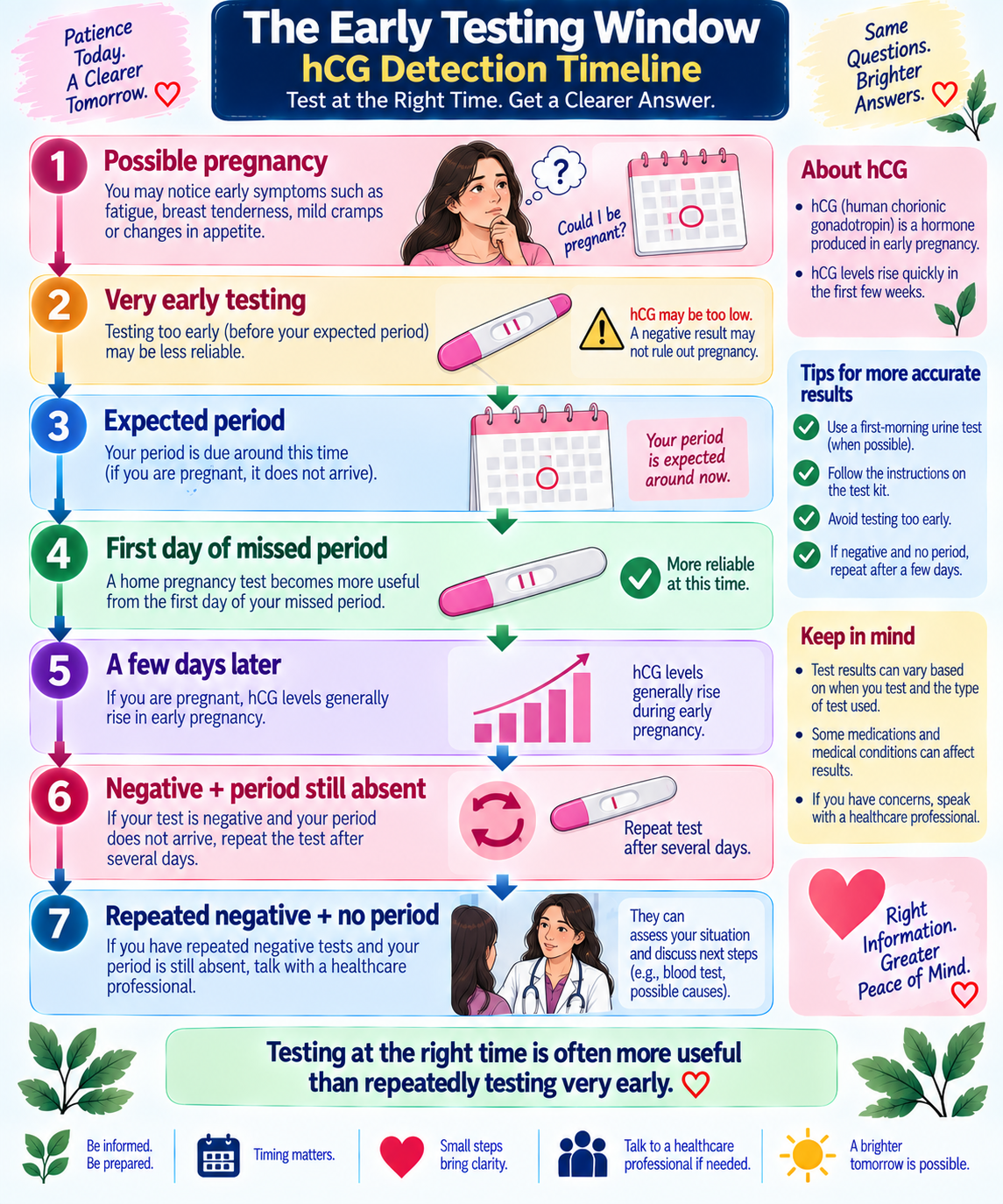
For most people, the most useful time to take a home pregnancy test is from the first day of the missed period.
If you do not know when your period is due, the NHS recommends testing at least 21 days after the last time you had unprotected sex. NHS pregnancy-test timing guidance
Some highly sensitive tests claim to detect pregnancy earlier.
However, an earlier test has a greater chance of being negative simply because hCG has not risen enough to be detected.
Mayo Clinic’s updated April 2026 guidance explains that home tests are more likely to be accurate after the first day of a missed period and that testing too early increases the risk of a false-negative result. Mayo Clinic’s April 2026 home pregnancy-test guidance
A Simple Testing Timeline
| Timing | What a test may show |
|---|---|
| Several days before the expected period | May be negative even if pregnant |
| Around the expected period | Detection becomes more likely. |
| First day of missed period | Most home tests can be used. |
| Several days after a missed period | A positive result is more likely if pregnant. |
| 21 days after unprotected sex when cycle timing is unknown | The NHS recommends testing by this point. |
This timeline is more useful than trying to identify one “magic” pregnancy symptom.
How to Take a Home Pregnancy Test Correctly
A pregnancy test is only as useful as the way it is used.
Follow these steps:
Check the expiration date.
An expired test may not perform as intended.
Read the instructions first.
Different brands have different procedures and result-reading times.
Use the correct urine sample.
Follow the manufacturer’s instructions about whether the test should be held in the urine stream or used with a collected sample.
Do not read the test too early or too late.
The manufacturer’s stated reading window matters.
Consider first-morning urine when testing very early
Mayo Clinic’s current guidance notes that concentrated first-morning urine can make hCG easier to detect, particularly when testing early. Mayo Clinic’s 2026 pregnancy-test guidance
The NHS, however, notes that urine for a pregnancy test can be collected at any time of day. NHS pregnancy testing guidance
So the practical message is simple:
Follow your test’s instructions, and if testing very early, first-morning urine may be helpful.
What If the Pregnancy Test Is Negative?
A negative test does not always mean that pregnancy is impossible.
If you tested before or around the expected period, hCG may still be too low for the test to detect.
If your period does not arrive, repeat the test after several days.
Mayo Clinic recommends repeating the test one week after the missed period if the initial result is negative but pregnancy is still suspected. Mayo Clinic’s current home-test guidance
The NHS advises waiting a few days and testing again if the first test is negative but pregnancy is still suspected. NHS pregnancy test guidance
If repeated tests remain negative and your period still does not arrive, speak with a healthcare professional.
What If the Pregnancy Test Is Positive?
A positive home pregnancy test generally means that hCG has been detected.
The next step is appropriate healthcare follow-up.
Depending on your circumstances, a healthcare professional may discuss:
- Your last menstrual period
- Medications
- Existing health conditions
- Prenatal vitamins
- Pregnancy dating
- Symptoms
- Blood tests
- Ultrasound when appropriate
Mayo Clinic recommends contacting a healthcare professional after a positive home pregnancy test so that prenatal care can begin. Mayo Clinic’s pregnancy guidance
Can a Pregnancy Test Be Wrong?
Yes, although home pregnancy tests are generally useful when used correctly and at the appropriate time.
False-negative results
A false negative can occur when:
- You test too early
- Ovulation occurred later than expected
- Implantation occurred later
- Urine is diluted
- The test is used incorrectly
- The result is read outside the recommended time
The timing of ovulation can vary between cycles, which is one reason early testing can be confusing. Mayo Clinic’s 2026 pregnancy-test guidance
False-positive results
False positives are less common but can occur.
Potential explanations include certain fertility medicines containing hCG and some uncommon medical circumstances.
ACOG published a 2026 clinical consensus discussing persistently elevated hCG results and emphasizes that clinicians should consider pregnancy, including intrauterine and ectopic pregnancy, before investigating other causes. ACOG’s 2026 clinical guidance on positive hCG results
What Is the Most Reliable Way to Confirm Pregnancy?
For most people, a properly timed home urine pregnancy test is the practical first step.
Healthcare professionals can also use blood hCG testing when clinically appropriate.
Blood testing can be particularly useful when:
- The situation is medically complicated
- Pregnancy timing is uncertain
- Symptoms are concerning
- A home test gives unclear results
- Ectopic pregnancy is suspected
- Pregnancy loss needs evaluation
Ultrasound may also be used when appropriate, but the timing depends on the clinical situation rather than a fixed number of weeks for everyone.
What If You Have Symptoms but the Test Is Negative?
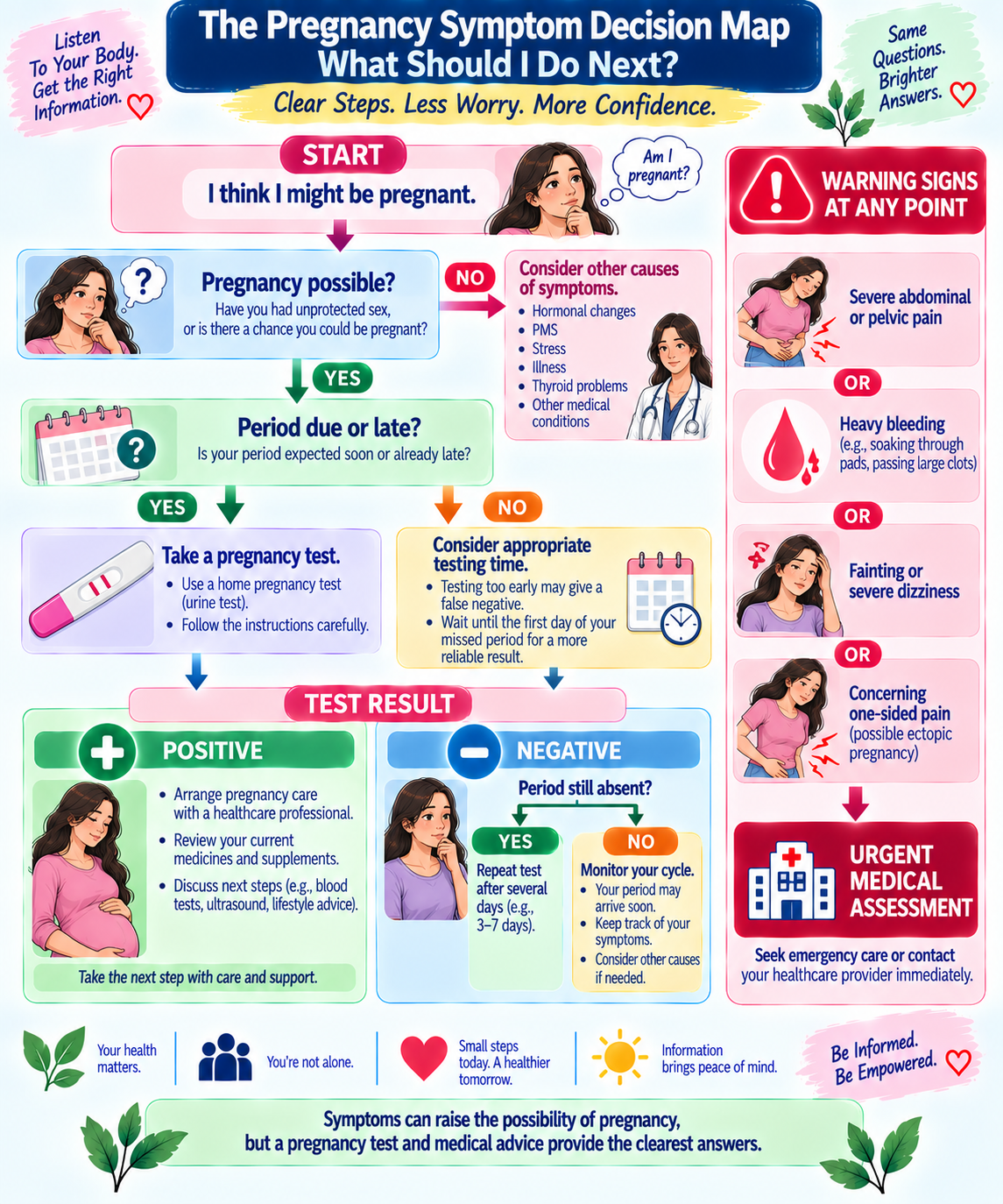
This is a very common situation.
Do not assume that a negative test means the symptoms are imaginary.
The symptoms may have another explanation.
Possible causes include:
- PMS
- Delayed ovulation
- Stress
- Sleep disruption
- Hormonal changes
- Illness
- Changes in weight
- Medication effects
If the period remains absent, repeat the pregnancy test or speak with a healthcare professional.
The goal is not to keep analyzing symptoms indefinitely.
Use symptoms to decide when to test, not as a substitute for testing.
A People-First Way to Track Early Symptoms
One practical approach that can reduce confusion is to stop checking your body every few minutes.
Instead, use a simple once-a-day record.
| What to record | Example |
|---|---|
| Period expected | September 20 |
| Period status | Not started |
| Breast changes | Mild tenderness |
| Cramping | Mild, intermittent |
| Fatigue | Moderate |
| Nausea | None |
| Test | Negative |
| Test date | September 20 |
| Next step | Repeat if the period remains absent. |
This creates a timeline instead of a collection of isolated sensations.
It can also make a healthcare appointment more useful.
A Simple “Should I Test?” Decision Guide
Could pregnancy be possible?
↓
Yes.
↓
Is your period due or already late?
Yes.
Take a home pregnancy test.
No
You can test early with some sensitive tests, but understand that a negative result may not rule out pregnancy.
↓
Positive
Contact a healthcare professional and begin appropriate pregnancy care.
↓
Negative, but the period is still absent.
Repeat the test after several days.
↓
Repeatedly negative + period still absent
Speak with a healthcare professional.
This approach is more reliable than trying to diagnose pregnancy from breast pain, cramps, or food cravings.
What to Do While Waiting for Confirmation
If pregnancy is possible, you do not have to wait for a positive test before making sensible health choices.
Avoid alcohol.
If pregnancy is possible, avoiding alcohol is a practical precaution.
Review medications.
Do not stop important prescription medicines suddenly.
Instead, ask your healthcare professional or pharmacist whether a medicine is appropriate when pregnancy is possible.
Consider folic acid.
ACOG recommends that people who could become pregnant take a prenatal vitamin containing at least 400 micrograms of folic acid daily, beginning at least one month before pregnancy and continuing during the first 12 weeks. Individual recommendations can differ. ACOG’s pre-pregnancy care guidance
Eat normally and stay hydrated.
There is no need for extreme dietary changes while waiting for a pregnancy test.
Focus on balanced meals, adequate fluids, and regular nutrition.
Do not start random supplements.
“Fertility” or “early pregnancy” supplements can contain ingredients that have not been adequately studied during pregnancy.
Ask a healthcare professional before starting new supplements.
A Unique Practical Idea: The Two-Column Symptom Check
One simple method that can help reduce unnecessary worry is to divide your notes into two columns:
What I noticed | What it can mean
For example:
Breast tenderness | Pregnancy, PMS, or hormonal changes
Mild cramps | Period approaching, early pregnancy, or other causes
Fatigue | Pregnancy, poor sleep, stress, illness, or other causes
Missed period | Pregnancy is possible, but other causes exist.
This teaches an important lesson:
One symptom can have several explanations.
The purpose of symptom tracking is therefore not to diagnose yourself. It is to identify when testing or professional advice makes sense.
Common Mistakes People Make
Mistake 1: Testing far too early
A negative result several days before the expected period may simply be too early.
Mistake 2: Treating every symptom as proof
Breast tenderness, cramps, and fatigue are not unique to pregnancy.
Mistake 3: Repeating tests several times in one day
If you test too early, taking several tests within a few hours may not provide useful additional information.
Waiting and retesting later is generally more informative.
Mistake 4: Ignoring the menstrual cycle
Knowing when your period is expected makes test timing much easier.
Mistake 5: Assuming no symptoms means no pregnancy
Some people have very few early symptoms.
The NHS emphasizes that every pregnancy is different and that not everyone experiences all early symptoms. NHS early pregnancy symptoms guidance
Mistake 6: Assuming spotting always means implantation
Bleeding can have many causes.
Do not use spotting alone to confirm pregnancy.
Mistake 7: Ignoring severe pain
Severe or one-sided pelvic pain should not be dismissed as a normal pregnancy symptom.
When Early Pregnancy Symptoms Need Urgent Medical Attention
Most mild early symptoms are not emergencies.
However, some symptoms require prompt medical assessment.
Seek urgent medical care if you have:
- Severe or worsening abdominal pain
- Severe pelvic pain
- One-sided pelvic pain
- Heavy vaginal bleeding
- Shoulder pain with other concerning symptoms
- Fainting
- Severe dizziness or weakness
- Significant pain accompanied by bleeding
These symptoms can occur with ectopic pregnancy or other complications.
ACOG warns that a ruptured ectopic pregnancy can cause major internal bleeding and is a medical emergency. ACOG’s ectopic pregnancy guidance
Early pregnancy bleeding also has several possible causes, so it should not automatically be assumed to be implantation bleeding. ACOG’s guidance on bleeding during pregnancy
Early Pregnancy and Exercise
If you think you might be pregnant, ordinary light-to-moderate physical activity is not something you need to fear simply because you are waiting for a test.
However, pregnancy can change exercise recommendations depending on your health, symptoms, and pregnancy status.
Avoid using intense exercise as a way to “test” whether you are pregnant.
If you experience significant pain, bleeding, dizziness, or another concerning symptom, stop exercising and seek medical advice.
Once pregnancy is confirmed, discuss your exercise routine with your healthcare professional, particularly if you have medical conditions or pregnancy complications.
What Recent Research and Guidance Has Changed?
One important development in 2026 is the continued refinement of how clinicians interpret hCG results.
ACOG’s February 2026 clinical consensus emphasizes that an unexpectedly positive or persistently elevated hCG result can have more than one explanation and should be evaluated systematically. Clinicians first need to establish whether pregnancy is present, including whether it is an intrauterine or ectopic pregnancy, before considering less common explanations. ACOG’s 2026 clinical consensus on positive hCG results
For readers, the practical lesson is important:
A pregnancy test is a powerful diagnostic tool, but the number should always be interpreted in context when medical concerns exist.
Another important current development is the continued emphasis on appropriate timing of home testing.
Mayo Clinic’s April 2026 update reinforces that testing after the first day of a missed period generally improves accuracy because hCG rises during early pregnancy. Mayo Clinic’s April 2026 home pregnancy test guidance
This supports a simple evidence-based message:
Better timing can be more useful than repeatedly testing very early.
What If You Are Unsure About Continuing the Pregnancy?
A positive test can bring very different emotions.
Some people may feel happy.
Others may feel frightened, confused, or uncertain.
Some may experience several emotions at the same time.
You do not need to force yourself to feel a particular way.
If you are unsure about what you want to do, speak confidentially with a qualified healthcare professional or an appropriate reproductive-health service. The NHS also provides information for people who are unsure about continuing a pregnancy. NHS guidance after a positive pregnancy test
Personal Insight Without Guessing What Your Body Means
One of the most useful lessons when waiting for pregnancy confirmation is that body awareness and medical confirmation are two different things.
- You can notice that your breasts feel different.
- You can notice that you are unusually tired.
- You can notice mild cramping.
Those observations are useful.
But they should lead to an appropriate next step rather than a conclusion.
Instead of asking:
“Does this symptom prove I am pregnant?”
ask:
“Is pregnancy possible, and is it now the right time to test?”
That small change can make the waiting period less confusing.
Frequently Asked Questions
Can you have pregnancy symptoms before a missed period?
Yes. Some people notice breast tenderness, fatigue, cramping, spotting, changes in smell, appetite changes, or other symptoms before a missed period. However, symptoms vary widely and can overlap with PMS. Mayo Clinic’s pregnancy symptom guide
What is the earliest sign of pregnancy?
There is no single earliest symptom that reliably confirms pregnancy. A missed period can be an important clue for someone with regular cycles, but a pregnancy test provides much stronger evidence.
Can you feel pregnant before a pregnancy test is positive?
You can experience physical changes before a test detects enough hCG. However, those symptoms cannot establish that pregnancy is the cause.
Can implantation bleeding confirm pregnancy?
No. Light spotting can occur in early pregnancy, but bleeding has several possible causes. It cannot confirm pregnancy by itself. ACOG’s information about early-pregnancy bleeding
How many days before a missed period can pregnancy symptoms start?
There is no reliable number of days that applies to everyone. Ovulation, implantation, and individual hormonal responses vary, so symptom timing differs.
When should I take a pregnancy test?
Most home pregnancy tests are most reliable from the first day of a missed period. If you do not know when your period is due, the NHS recommends testing at least 21 days after the last episode of unprotected sex. NHS pregnancy test guidance
Can I be pregnant with no symptoms?
Yes. Not everyone experiences noticeable early pregnancy symptoms. NHS early pregnancy symptoms guidance
Can PMS feel exactly like early pregnancy?
PMS and early pregnancy can share symptoms such as breast tenderness, fatigue, mood changes, bloating, and cramps. A pregnancy test is more useful than trying to distinguish the two based only on symptoms.
What if my pregnancy test is negative but my period does not come?
Wait several days and repeat the test. If repeated tests remain negative and your period still does not arrive, contact a healthcare professional. Mayo Clinic’s current pregnancy test guidance
Can a home pregnancy test be positive before a missed period?
Some sensitive tests may detect pregnancy before a missed period, but testing this early increases the possibility of a false-negative result. Waiting until the expected period or after it is generally more reliable. Mayo Clinic’s 2026 pregnancy-test guidance
Does morning urine give a more accurate pregnancy test?
When testing very early, first-morning urine may contain a higher concentration of hCG and can make detection easier. The NHS notes that pregnancy tests can also be performed using urine collected at other times of day. Mayo Clinic’s 2026 testing guidance NHS pregnancy testing guidance
Should I see a doctor after a positive home pregnancy test?
Yes, arrange appropriate healthcare follow-up. This allows pregnancy care to begin and gives you an opportunity to discuss medications, health conditions, supplements, and any symptoms. Mayo Clinic’s pregnancy guidance
Final Thoughts
Early pregnancy symptoms before a missed period can be real, but they can also be confusing.
Breast tenderness, fatigue, mild cramps, spotting, nausea, food changes, and increased urination may occur during early pregnancy. Yet many of the same symptoms can happen before a period or for completely different reasons.
That is why symptoms should be treated as clues rather than confirmation.
If pregnancy is possible, pay attention to your menstrual timing and use a properly timed pregnancy test. Testing too early can produce a false-negative result, while waiting until the first day of a missed period generally gives a more reliable answer. Mayo Clinic’s April 2026 pregnancy test guidance
A positive result should be followed by appropriate healthcare.
A negative result does not always end the question if testing was early or the period still has not arrived.
Most importantly, do not ignore severe pain, significant bleeding, fainting, weakness, or other concerning symptoms. Early pregnancy complications, including ectopic pregnancy, can require urgent care. ACOG’s ectopic pregnancy guidance
The most useful approach is simple:
Notice your body → understand the timing → test at the right time → repeat when appropriate → seek medical care when symptoms are concerning.
That approach provides more clarity than trying to diagnose pregnancy from one symptom.
Author Note
RVLNSV PRASAD creates health and wellness content with an emphasis on clear, evidence-based information and practical guidance for everyday readers.
This article was written to help readers understand early pregnancy symptoms, pregnancy test timing, and situations that require medical attention. It does not assume that a particular symptom means pregnancy.
Personal pregnancy experiences can differ substantially, so this article does not use invented patient stories or unverified personal medical experiences as evidence.
Medical Disclaimer
This article is intended for educational purposes only. It cannot diagnose pregnancy, miscarriage, ectopic pregnancy, or another medical condition.
Pregnancy tests, blood tests, ultrasound examinations, and clinical assessments may be needed depending on the circumstances.
If you have severe abdominal or pelvic pain, heavy bleeding, fainting, severe dizziness, shoulder pain with concerning symptoms, or feel seriously unwell, seek urgent medical care.
Do not stop prescription medicines or begin new medicines or supplements based only on information in this article.
Fitness Disclaimer
If pregnancy is possible, do not use exercise intensity, abdominal exercises, or other physical activity to determine whether you are pregnant.
If you experience bleeding, significant pain, dizziness, or other concerning symptoms, stop exercise and seek medical advice.
Once pregnancy is confirmed, discuss your exercise routine with your healthcare professional, especially if you have a medical condition or pregnancy-related complication.
Sources
- Mayo Clinic — Home pregnancy tests
- NHS — Doing a pregnancy test
- NHS — Early pregnancy signs and symptoms
- Mayo Clinic — Symptoms of pregnancy
- ACOG — Ectopic pregnancy
Related Content
- 10 Best Core Exercises for Beginners at Home: Build a Stronger Core Without Equipment
- Stronger Every Day: The Science-Backed Path to Peak Fitness
- 6 Home Exercises for Overall Fitness and Flexibility: A Comprehensive Guide
- Ctrgory Holistic wellnes
- 10 Severe Depression Warning Signs
- Integrating Holistic Wellness Into Your Daily Routine: A Comprehensive Guide to Total Well-Being
- 10 Early Signs Of Heart Failure








[…] Pregnancy Confirmation Early Symptoms […]
[…] Pregnancy Confirmation Early Symptoms […]
[…] Pregnancy Confirmation Early Symptoms […]
[…] Pregnancy Confirmation Early Symptoms […]
[…] Pregnancy Confirmation Early Symptoms […]
[…] Pregnancy Confirmation Early Symptoms […]